A Level English Literature
Prose, Poetry and Drama are the three pillars that make up the study of English Literature at A Level. You will study all three aspects and will compare texts, whilst considering the context in which they were written, as well as when they were set.
English Literature does involve a great deal of reading and writing analytically about the texts whilst taking into account the critical views of others. Being an avid reader is an essential skill for being successful in English Literature.
Do you think you have what it takes to be successful in this subject? To prepare yourself for further study and the start of your course you may want to undertake some of the following:
Reading
The Great Gatsby – F Scott Fitzgerald (Prose)
Death of a Salesman – Arthur Miller (Drama)
Beloved – Toni Morrison (Prose)
King Lear – William Shakespeare (Drama)
The Picture of Dorian Gray – Oscar Wilde (Prose)
A Streetcar Named Desire – Tennessee Williams (Drama)
Additional Reading
Read an additional text from the writers above to experience more of their work. You will have already read something by Shakespeare as part of your GCSE, and it is possible you may have already come across Arthur Miller if you have studied The Crucible.
Watching/listening
Many theatre companies are offering free access to their productions of some of the plays listed above and many others
http://www.nationaltheatre.org.uk/
http://www.shakespearesglobe.com/
You may also have access to ‘audible’ on Amazon, so you can listen to a reading of the prose texts. The Picture of Dorian Gray is available as a free audible book on stories.audible.com
There are also movie versions of all three prose texts, including Gatsby which is currently available on Netflix. Dorian Gray, King Lear, and Death of a Salesman are all available if you have Amazon Prime. The more you can read (and watch or listen to) over the next few months the more prepared you will be for the rigours and demands of A Level English Literature. Good luck and enjoy your reading.
A Level English Language Workbook.
Getting a head start in HISTORY
History teachers at Furness College will provide a variety of materials for aspiring Historians to work on between now and what we hope will be the start of a new academic year in September 2023.
Students who have already expressed an interest in History A Level, and any others who are just interested in History, are welcome to take part in the activities, quizzes and competitions which will be posted throughout the coming months.
To take part, students need to visit our website – histpology.co.uk (the site has a secure SSL certificate) – and look for the ‘MOVING ON UP’ pages in the History section.
The ‘MOVING ON UP’ pages directs students to
- Specific and challenging things to read
- Specific (and often funny) things to watch
- Links to a wide-range of excellent History podcasts
- Ideas for thinking, arguing and writing about History
Our first competition (submissions by email) challenges students to think of the best items they would put in a ‘Covid-19’ time-capsule alongside the obvious face mask and hand sanitiser. In September, new History students will decide what articles to include and the capsule will be hidden somewhere in the grounds of Furness College.
Staff are happy to be contacted by email:
Caroline – caroline.buckley@furness.ac.uk
Steve – steve.buckley@furness.ac.uk
Students who use Twitter may also get updates from @Histpology.
All welcome!
Have a go of the tasks below to help prepare you for this course in September.
- Find definitions for the following key terminology;
- Domestic Tourism.
- Intangibility.
- Recession.
- Interrelationships.
- Vertical Integration.
- Pandemic.
There are many different factors which can impact upon a destinations tourism industry. This can include many external factors, which we would struggle to control such as terrorism, a natural disaster or a major health issue.
Do some research in to the impact Coronavirus is having on the tourism industry in Wales. Note key statistics and tourism organisations most affected. Use the link below to help;
https://www.bbc.co.uk/news/uk-wales-51925657
- Tourism organisations operate within either the Public/Private or Voluntary sectors. Complete the table below by finding out which type the given organisations belong to.
| Example Organisation | Sector |
|
TUI |
|
|
VISIT BRITAIN |
|
|
THE NATIONAL TRUST
|
Find the right path for you with Careermag for School Leavers.
Get proof of ID
You’ll need some form of identification when you enrol at Furness College in September, so having an up-to-date passport, driving licence, provisional driving licence, bank card or CitizenCard really speeds up this process. You’ll also need ID for things such as opening a bank account or as proof of age, so keeping your ID up to date will make things easier for you.
Click here to apply for a CitizenCard.
Open your own bank account
Bank accounts help to build your credit score, which will help you in the future when it comes to seeking credit, whether this be for purchases, products or mortgages. Opening a bank account usually requires two forms of ID, which is another good reason to have up-to-date ID! This is usually photo ID, such as a passport, and proof of name and address, such as a bill or a letter. You can open a current account at most banks on the high street or some banks have the option to apply online.
Click here to find out more about opening a bank account.
Bursary
If your household income is under £23,000 then you may be entitled to support from the College bursary, this may include help towards travel costs; college meals and/or kit and equipment. Please ask your parent or carer to check out further information on our Financial Support page.
We will be able to send you an electronic application form if you send a request to info@furness.ac.uk
Have you received your National Insurance Number?
Your National Insurance (NI) Number is a personal account number that will be used throughout your life by HM Revenue and Customs and other important organisations. Having a National Insurance number shows you have the right to work and study in the UK and ensures your National Insurance contributions and tax are recorded against your name only.
You’ll normally be sent a National Insurance number automatically, in the 3 months before your 16th birthday, if both the following are true:
• you live in the UK
• a parent has filled in a Child Benefit claim form for you
If you’re aged 16 to 19 and have not yet received one, contact HM Revenue and Customs.
Keep copies of your certificates
Certificates are important to prove your qualifications and competencies, and all employers will ask for these, usually during the interview and selection process. Create a folder of plastic wallets, add your certificates in as you achieve them and make sure the folder is kept in a safe place that you can easily access. If you lose your certificates, copies can cost around £35 per certificate to replace and you have to know the examination body and the place of study when applying for a replacement.
Check out the opportunities on offer at Furness College
At Furness College, we encourage you to actively take part in the many extracurricular opportunities on offer such as:
• Freshers’ Fair
• Fundraising events for local and national charities
• Students’ Union/Course Reps/Learner Voice
• Work experience opportunities
• Opportunities to compete at County and National Level in athletics and cross country
• Gold Duke of Edinburgh
• National Citizen Service
All of them would make worthy additions to your CV or UCAS application to show universities or prospective employers that you have encompassed the full experience of college life and have been prepared to step out of your comfort zone and take part. We will do our very best to make your time with us a memorable one!
Furness College Students’ Union (FCSU)
Regardless of which campus you attend, every learner is a member of the Students’ Union. You can benefit hugely by being a Student Representative or Officer as the experience will develop your confidence and improve your communication, organisational and teamwork skills. All these personal attributes are much sought after by employers and universities. Check out more information here.
Keep up to date with the Students’ Union by following:
Facebook: Furness College Students’ Union
Instagram: Furness College Students’ Union
Twitter: @theFCSU
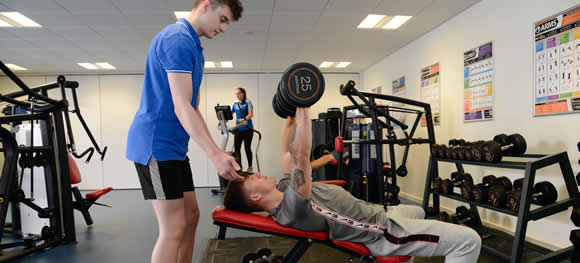
Get fit for less with our fantastic sports facilities
With its £47 million campus, Furness College provides a suite of state-of-the-art sporting venues to join or for hire.
We offer a student gym membership for students from all campuses for £36 a term (£9 a month). There’s a £6 joining fee which includes initial induction and fitness programme if desired.
Careers Advice and Guidance
The College has a team of Career Professionals who not only advise and guide you once you are studying at College but are available to provide support now should you have any questions. We also work closely with Inspira and Hello Future to ensure we enhance your package of career support. It is never too early to consider what kind of jobs you would like to do in the future! Please look at our page on Planning your Future for more information and useful resources.
There have been many changes in the Education sector and far greater emphasis is now paid to maths and English.
The Government recently introduced study programmes. A core principle of study programmes is that any student who has not achieved grade 4/5 or grade A* to C or above in maths and/or English GCSE, by age 16, must continue to work towards achieving these qualifications. Therefore, every full-time learner aged 16 -19 years old who undertakes a programme of study at Furness College will continue with maths and English, either on discrete maths and English courses or embedded within their curriculum.
We offer GCSE Mathematics with AQA. A link to their website with resources is here:
GCSE Mathematics specifications at a glance
The best way to improve your maths is to do a little every day: learn your times tables; think about how you use maths every day; install maths games on your device.
Useful resources:
Corbettmaths
DrFrostMaths
GCSE AQA Maths
There have been many changes in the Education sector and far greater emphasis is now paid to maths and English.
The Government recently introduced study programmes. A core principle of study programmes is that any student who has not achieved grade 4/5 or grade A* to C or above in maths and/or English GCSE, by age 16, must continue to work towards achieving these qualifications. Therefore, every full-time learner aged 16 -19 years old who undertakes a programme of study at Furness College will continue with maths and English, either on discrete maths and English courses or embedded within their curriculum.
The most important thing you can do to support your success in English, at any level, is to read for twenty minutes every day. Anything that is written well, in full sentences and paragraphs, will improve your reading stamina and skills. This might include:
• Books – fiction or non-fiction
• Magazines – physical or on-line
• Newspapers – physical or on-line
• Web Articles
• Blogs
If you don’t have access to physical books at home, there are some places on-line where you can download and read books for free, such as:
• Amazon Kindle – download the app to your phone, computer or tablet and you will find lots of books available for free (although some do need to be purchased)
• Project Gutenburg – they have over 61,000 books available on-line to download for free
• ManyBooks – a website with free classics and also some new, modern authors
We offer GCSE English Language with AQA. A link to their website with resources is here;
Functional skills maths is divided in to two sections; calculator and non-calculator – you need to pass both to achieve the full award and involves looking at maths we use every day and thinking about we use maths to solve problems.
Practical activities, resources and games can be found here:
Functional skills English is divided in to three elements; Reading, Writing and Speaking & Listening – you need to pass all elements to achieve your award. Any kind of reading will help you with your functional skills English. However, if you would like some practical activities to try, further resources can be found at the links below:
Barrow-In-Furness
Cumbria
LA14 2PJ
Barrow-In-Furness
Cumbria
LA13 9LE
Tel: 01229 828 377 (The Sixth Form)
Email: info@furness.ac.uk